
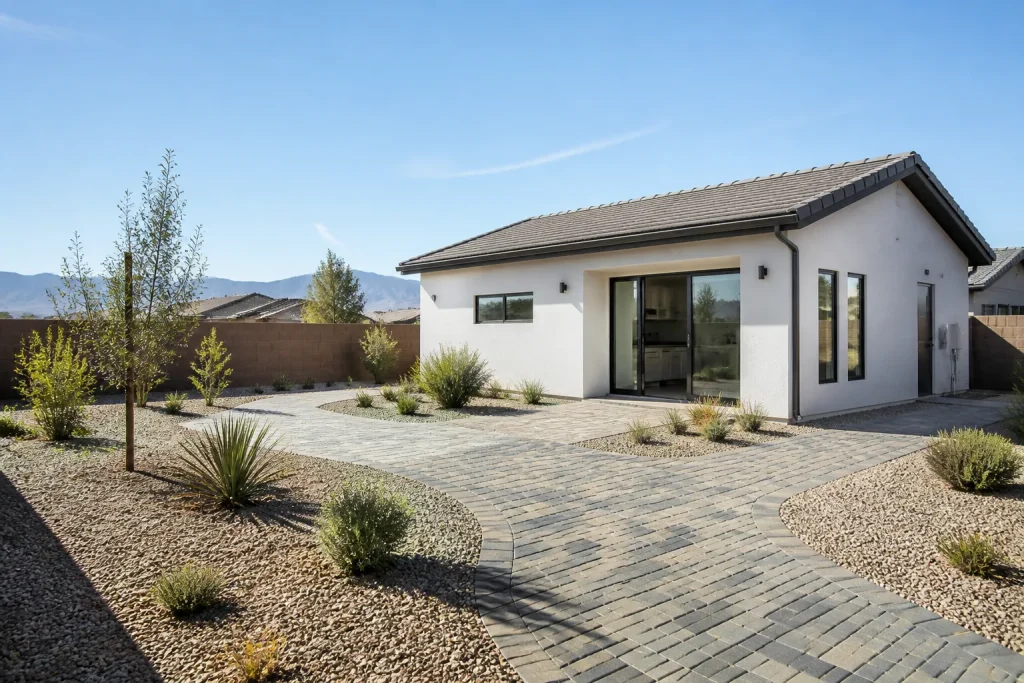
ADU Builders Pricing Breakdown: What Enterprise Homeowners Pay in 2026
The same 500-square-foot ADU built by the same contractor can legitimately cost $95,000 or $145,000 on two different Enterprise lots, and the difference has almost nothing to do with the floor plan. That spread is what makes per-square-foot pricing so unhelpful on its own. Two properties on the same block, zoned the same way, can land at very different totals once lot conditions, utility upgrades, and finish level get factored in. If you’re budgeting for 2026 and you want a number you can actually plan around, you need to understand what moves the cost up and down.
If you’d rather not sort through the variables yourself, call (866) 811-9288 and we’ll walk through your specific property with you. Estimates are free.
Why Per-Square-Foot ADU Pricing Fails in Enterprise
A $180-per-square-foot ADU quote and a $290-per-square-foot quote can both be honest. The number depends on six things, and only two of them relate to the square footage itself.
- Lot conditions: Soil, slope, drainage, and access to the build site. A flat lot with a clear path in is a different project from a lot that needs grading or has restricted equipment access.
- Utility upgrade requirements: What the panel, water service, and sewer or septic can handle without changes.
- Foundation type: Slab, stem wall, or something more involved depending on the soil and grade.
- Finish level: Builder-grade materials versus custom tile, cabinets, and fixtures. This is the single biggest controllable lever in the budget.
- ADU type: Garage conversion, site-built addition, or prefab. More on this below.
- Permits and fees: Clark County and city-level fees factor into every project, and they vary by scope.
Sort through those six variables and the price range narrows dramatically. Skip them and you’re guessing.
Itemized Cost Breakdown by Project Phase (2026 Las Vegas Market)
Here’s the 2026 cost breakdown by phase for a typical site-built ADU in the Las Vegas Valley market. Ranges are estimates only. The written estimate sets the final price.
| Phase | Typical Cost Range |
|---|---|
| Site prep and grading | $4,000 – $10,000 |
| Foundation | $8,000 – $18,000 |
| Framing and structure | $20,000 – $38,000 |
| MEP rough-in (plumbing, electrical, mechanical) | $15,000 – $28,000 |
| Insulation and drywall | $5,000 – $10,000 |
| Finishes (flooring, cabinetry, fixtures, paint) | $18,000 – $45,000 |
| Permits and plan review | $5,000 – $12,000 |
| Clark County impact fees and utility connections | Varies by lot and service; confirm with the county |
Add those ranges and you land between about $75,000 and $161,000 for a full ground-up ADU in the Enterprise area, depending on scope and finish level. That tracks with the $95,000-to-$145,000 spread we opened with. The middle of that range is where most projects land once a homeowner settles on a mid-grade finish level and doesn’t run into major lot issues.
Clark County Impact Fees and Utility Connections in Enterprise
Impact fees and utility connection costs are separate line items from your construction budget, and they’re easy to forget until they show up on a permit application. They depend on the property’s current utility status and the type of ADU being built.
- Sewer connection: If the property is already on a sewer lateral, the ADU can usually connect with a new tap. If it’s on septic, that changes everything, and a septic evaluation is the first call to make.
- Water service: An existing meter may or may not have capacity for a second dwelling unit. A plumber’s assessment is part of the design process for a reason.
- Impact fees: These are assessed by Clark County and vary by the ADU’s size and use. We confirm the figures with the county during plan review, before plans are final.
Older Enterprise lots built decades ago sometimes have smaller service lines than newer construction, which can trigger an upgrade that wasn’t in the original budget. That’s not a reason to abandon the project. It’s a reason to price it accurately up front.
Garage Conversion vs. Site-Built Addition vs. Prefab: The Real Cost Comparison
Garage conversions are typically the lowest-cost ADU path because the structure already exists. A site-built addition sits in the middle. A premium prefab fits in around the middle-to-upper range but trades timeline risk for a known cost. Here’s how the three compare.
- Garage conversion: Roughly $45,000 – $85,000. You’re turning existing square footage into income or independence. Electrical, plumbing, insulation, and interior finishes make up most of the cost. Fewer unknowns, less site disruption.
- Site-built addition: Roughly $95,000 – $145,000. Full custom control, complete independence from the main house, and the widest range of design options. Also the most variables to manage.
- Prefab (Abodu, Cover, Dvele): Roughly $100,000 – $160,000 installed and finished, depending on the model and site conditions. Pre-engineered designs can reduce permitting friction because the plans have typically been reviewed before. You trade some design freedom for a more predictable build.
None of these is inherently better. Your property, your ADU strategy. A garage that’s already plumbed and wired for a workshop is an obvious conversion candidate. A lot with room for a real footprint and a homeowner who wants a fully independent unit is a site-built candidate. And a homeowner who values a factory finish over custom tile is a prefab candidate. Our ADU builders work across all three, so the recommendation follows the property, not the method.
The Hidden Line Items Most ADU Calculators Skip
Online calculators almost always miss these, and any of them can add real money to the total.
- Electrical panel upgrade: A second dwelling unit often needs more capacity than the existing panel can provide. This is one of the most common surprises.
- Sewer lateral extension: The ADU has to reach the main line. If the run is long, the trenching and material add up.
- Grading and drainage: Water management around a second structure on an existing lot is not optional. Improperly graded, an ADU becomes a water problem.
- Landscaping restoration: Construction equipment tears up more of the yard than homeowners expect, and restoring it is a real cost.
- HVAC and mechanical: A separate unit needs its own system, not a tie-in to the main house.
These are the items where an accurate, itemized written estimate matters most. A quote that doesn’t break out the hidden line items is not a lower price; it’s an incomplete one.
Financing Your Enterprise ADU in 2026
Most Enterprise homeowners fund an ADU through home equity rather than cash, and there are three common paths.
- Home equity line of credit (HELOC): Draw-as-you-build, which pairs well with phase-by-phase construction payments. Rates track the prime rate.
- Cash-out refinance: Replaces your existing mortgage and frees equity at a fixed rate. Makes sense if you’re planning to keep the home and want predictable payments.
- ADU-specific construction loans: Lenders that understand ADU projects are more common now, and they typically want plans and a written construction estimate before approval. This is where a detailed, line-item estimate from your builder becomes genuinely useful.
Your equity position drives the math. A homeowner with 40 percent equity can typically borrow more comfortably than one with 20 percent. A lender or financial advisor can walk you through specifics based on your situation.
When to Call a Pro
Some steps in an ADU project are genuinely a professional’s job. Electrical panel work, gas line connections, sewer lateral trenching, and anything structural belong in the hands of a licensed contractor. If you’re early in the process and weighing whether a garage conversion, custom site-built, or a prefab from Abodu or Dvele makes sense, our Casita Builders Enterprise team includes technicians with up to 10 years of experience, and we work in all three ADU pathways so we can recommend the right one for your lot rather than the one we prefer to build.
Related services in Enterprise: a room addition contractor can help if your project involves expanding the main home, and our Summerlin team covers nearby neighborhoods with the same ADU-only focus.
The Bottom Line
ADU costs in Enterprise depend more on lot conditions, utility requirements, and finish level than on whether you build a garage conversion or a site-built addition. A garage conversion starts around $45,000. A site-built ADU runs about $95,000 to $145,000 once the real variables get factored in. A prefab from Abodu, Cover, or Dvele lands in a similar range with a more predictable build. Hidden line items like panel upgrades and sewer lateral extensions are where budgets go sideways, so ask for an itemized estimate that shows them.
If you’re in Enterprise and want a number you can trust, Casita Builders Enterprise offers free estimates with written line-item quotes. Call (866) 811-9288. We answer 24/7. Fast dispatch from 7am to 7pm, Sunday through Friday.
Frequently Asked Questions
A garage conversion typically runs $45,000 – $85,000, a site-built ADU runs $95,000 – $145,000, and a premium prefab runs $100,000 – $160,000 installed, depending on finish level and lot conditions. Call (866) 811-9288 for an exact quote – estimates are free.
It shouldn’t. Our written estimates break out each phase so the price is set before demolition or groundbreaking. Change orders only happen when you request a design change or when a condition found during construction (bad soil, undersized panel) is flagged and approved in writing. Call (866) 811-9288 to get a written estimate for your project.
Yes. ADU projects require permits and plan review through Clark County, and our team handles the applications and inspections. We confirm all local ADU rules with the county and city planning department before plans are final, since requirements depend on your specific lot. Call (866) 811-9288 to talk through the permitting process for your property.
The schedule depends on the ADU type, whether plan review requires revisions, and what’s found during site prep. We set a firm construction schedule in your written estimate so you know what to expect. Call (866) 811-9288 and we’ll walk you through a realistic timeline for your lot.
Written by the team at Casita Builders Enterprise.
Need ADU Help?
Call Casita Builders Enterprise - licensed & insured, here with fast help in Enterprise.
(866) 811-9288